
Gentle Mobility: adaptive yoga for everyday movement
Recently I was talking with one of our teachers about the inevitability of needing to tweak offerings after what you imagined to be a well-thought-through class meets the real world and is, in fact, not as perfectly placed or named as you had hoped it would be.
And really, a name or time change isn’t that big of a deal. It requires new printed schedules and some renewed efforts to get the word out, but what you get in return — an offering more aligned with the true desires of the community you’re serving — is well worth the printing costs.
And while I’m sure there will be more changes to come, the first is the renaming of our Saturday morning Gentle All Levels class to the only slightly different Gentle Mobility.
While we’re changing the copy on the website and booking software, I thought I’d write a little about this class — who it is for, how it came to be, and what actually happens in the room.
For a few years now, my father, now in his 60s and dealing with chronic pain, old injuries, and reduced mobility, has asked me if I could recommend a yoga class for him. Frustratingly, in a city teeming with excellent studios and teachers, I never knew quite where to send him.
Even the most seemingly accessible classes — classes using words like “gentle,” “slow,” “stretch,” or “restorative” — weren’t quite right. And this is not to denigrate those teaching them; I was teaching them too. As much as these classes served a certain audience, they were often less accessible than they appeared, something that can be easy to miss if you yourself are relatively mobile and able-bodied.
Many classes quietly assume the student can move easily from standing to the floor and back up again. They assume comfort kneeling, sitting cross-legged, bearing weight through the wrists, or understanding the language of movement instruction.
Group classes often ask students to adapt themselves to the class, rather than asking the class to adapt to the student. And while the language may be well-meaning, phrases like “do what feels good in your body” can be surprisingly difficult to navigate for students who are still learning how to listen to their bodies carefully. Likewise, telling a student to “modify as needed” is only useful if the student has been taught how to modify in the first place.
Accessibility is a word often used in the yoga world. We want movement practice to feel available to everyone, no matter the body they are in. But that requires more of the teacher than just reassuring language — it requires craft.
Adaptive yoga begins with the body in front of you.
It is the ongoing practice of observing carefully, teaching responsively, and shaping movement around the needs of the individual rather than the assumptions of the sequence. Props, alternative shapes, pacing, and thoughtful sequencing become tools not for simplification, but for relationship — helping each student find a meaningful way into practice.
That is the spirit Gentle Mobility was built from.
In practice, Gentle Mobility is about cultivating a more easeful relationship with movement itself: learning how to bend, turn, reach sit, stand, breathe, and transition through daily life with a little less strain and a little more awareness.
To support that, we use chairs, walls, ropes, blankets, bolsters, and other props liberally. Movements are broken down into smaller, more approachable pieces, and the pace is intentionally unhurried. Emphasis is placed on breath, coordination, and learning how to listen carefully to the body over time.
That is not to say that traditional asanas are left behind in favor of simpler movement. In many ways, the postures themselves are the means through which we study breath, coordination, balance, mobility, and attention.
The task, then, is not to abandon the pose when a student cannot access its standard form, but to adapt the pose to the student.
A student who struggles with a posture does not simply need permission to skip it. They need a teacher who understands what the posture is asking for, and who can creatively help them experience its essential actions. While we won’t always do it perfectly, our teachers have made the earnest commitment to try.
Gentle mobility is designed for students who may feel underserved by a typical yoga class — beginners, older students, students recovering from injury, people in bodies that may not feel easily accommodated by general classes, or anyone looking for a slower and more adaptive approach to movement.
At the same time, this class is truly for everyone. We can all benefit from slowing down, refining attention, and entering into a quieter, more spacious relationship with the body, where asana is not a fixed shape to achieve, but an ongoing education in embodiment.
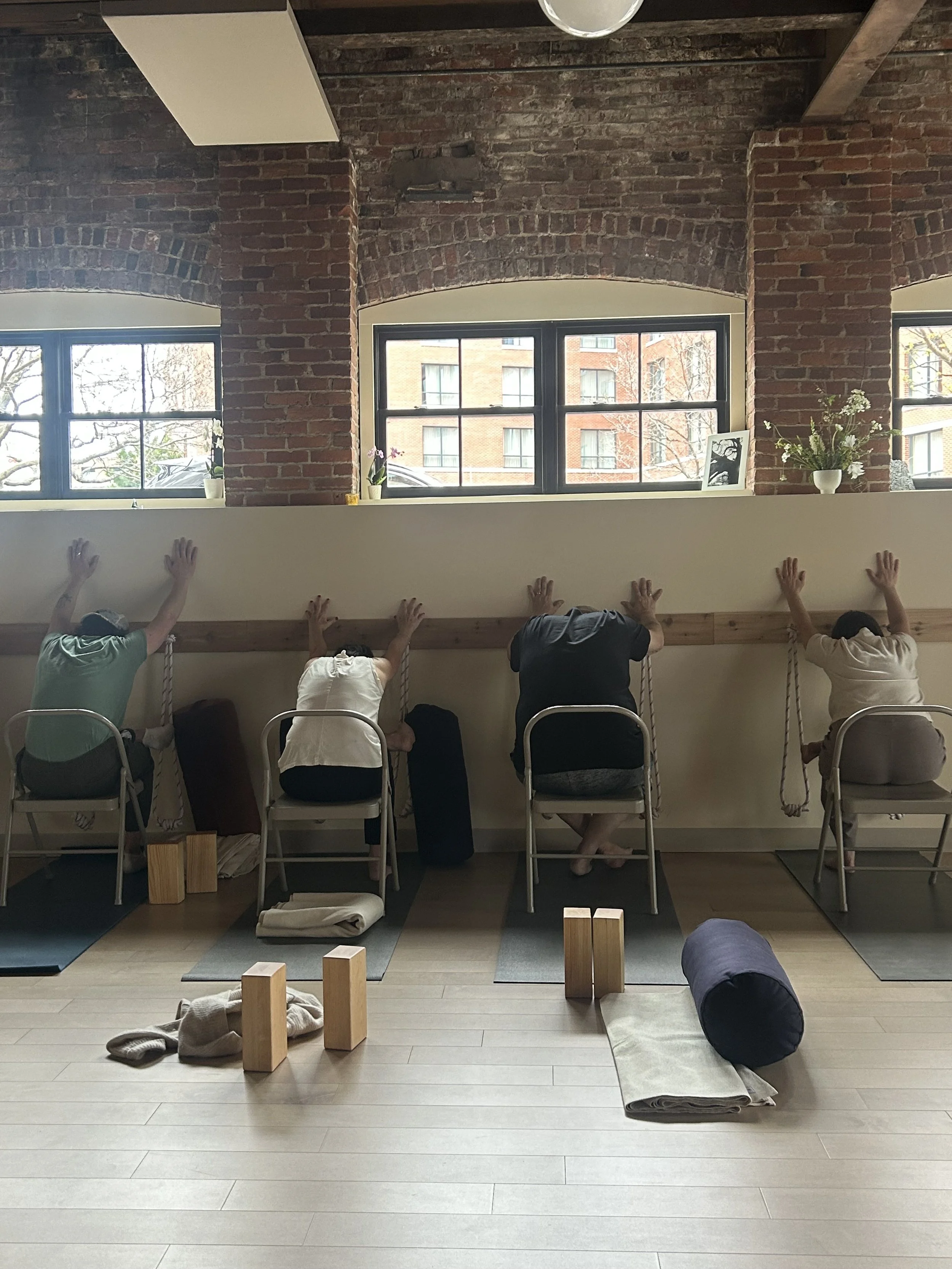
If you or someone you know might benefit from a Gentle Mobility class, please join us on Saturday mornings from 10-11:15 am at Una Yoga in downtown Portland, Maine.
